


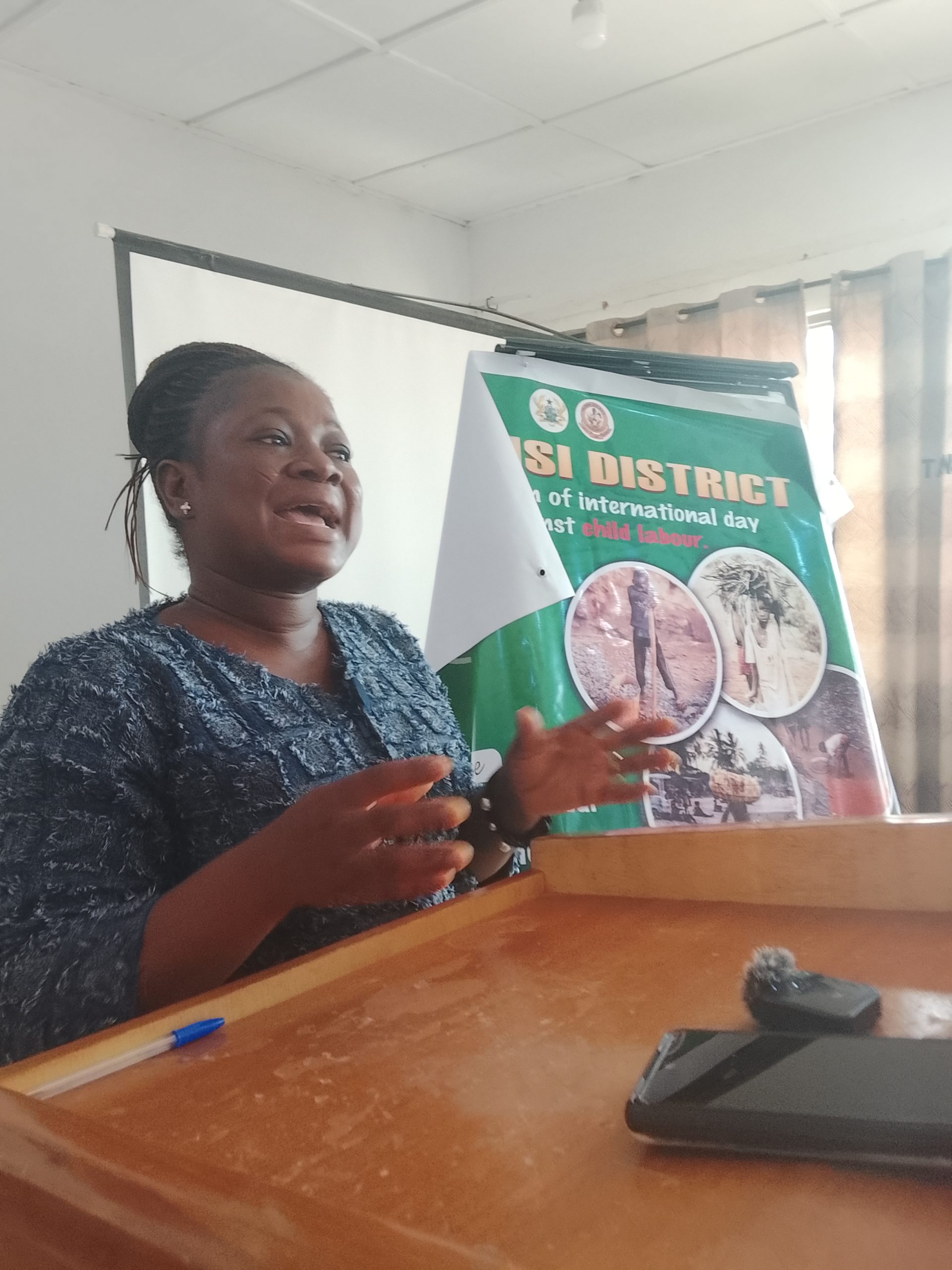
Joyce Ayinbono Adinmah (Gender Desk Officer, Talensi District)
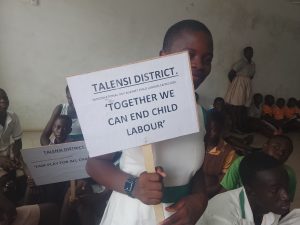
In a passionate address marking the World Day Against Child Labor, the Gender Desk Officer, Joyce Ayinbono Adinmah, has issued a stirring call to action, urging community leaders, teachers, and parents to unite in protecting the district’s children from exploitation.
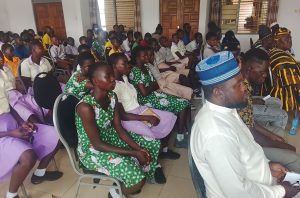
Speaking to a gathering that included local chiefs, elders, and residents, Adinmah highlighted the alarming prevalence of child labor within the district and emphasized that safeguarding the future of the younger generation is a shared responsibility. “We are here today celebrating the World Day Against Child Labor,” Adinmah stated. “We know that in our district, this issue is rampant. We are trying our best to see how we can reduce it, but this is not a task for our office alone, it is a responsibility for all of us, especially our community leaders and our teachers.”
Adinmah clarified that the campaign against child labor is not meant to stop children from learning responsibility at home. Instead, it targets work that exceeds a child’s physical capacity and threatens their well-being.
Undertaking age-appropriate household chores does not qualify as child labor but when children are subjected to tasks that transcend their physical strength and development, it crosses the line into exploitation.
“We are not saying children shouldn’t work at all,” Adinmah explained. “At the very least, they should only perform tasks within their capability and capacity. When they help with basic household chores, we do not call that child labor. But when they are overworked and given tasks beyond their strength, they lose their happiness.”
The Gender Desk Officer warned that overworking children causes profound, long-term psychological damage, stripping away their confidence and hindering their development into healthy adults. Overworked children frequently struggle with low self-esteem and social anxiety. Children denied a normal childhood often grow into depressed or easily angered adults due to unresolved childhood frustrations.
“We want to raise happy children so that, in the future, we will have happy, emotionally stable adults who do not suffer from depression,” Adinmah noted. “When a child is chronically overworked, they lose their confidence. They carry that lack of confidence into adulthood. You will see grown-ups who react with anger to the slightest provocation simply because they were denied the joys of childhood. We aren’t saying parents must provide luxury, but at least let a child be a child.”
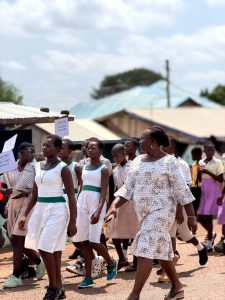
Ms Joyce Ayinbono Adinmah specifically condemned the practice of forcing children into hazardous environments, such as illegal mining (galamsey) sites, and pulling them out of classrooms to work on farms, a trend that typically spikes during the current rainy season.
“We must allow them to play and interact with their peers, because that is how they learn. We must stop sending them to “galamsey” areas. Children are not supposed to take care of us; we are supposed to take care of them.”
She acknowledged that while children can assist on family farms, this must never come at the expense of their education.
“Some parents, instead of sending their children to school, send them to the farm. Since we are in the rainy season, we are going to see a lot of this happening. This is exactly what we are speaking against. When it is time for school, let them go to school. If they must help on the farm, they can do so after school hours. Education must never be denied.”
Sharing a personal observation from her neighborhood, Adinmah criticized a local mother who routinely keeps her child home from school to grind maize or millet at the granary mill. “That is not right,” Adinmah insisted. “As parents, we can and should do those tasks ourselves.”
Concluding her address, Adinmah turned to the traditional rulers and elders present, appealing for a synchronized community effort to combat the menace.
“I am entreating all of you, our fathers, elders, and chiefs who are gathered here today, this is our collective responsibility. We must come together, even if we cannot eradicate child labor entirely overnight, we must work hand-in-hand to drastically minimize it within our communities.”